


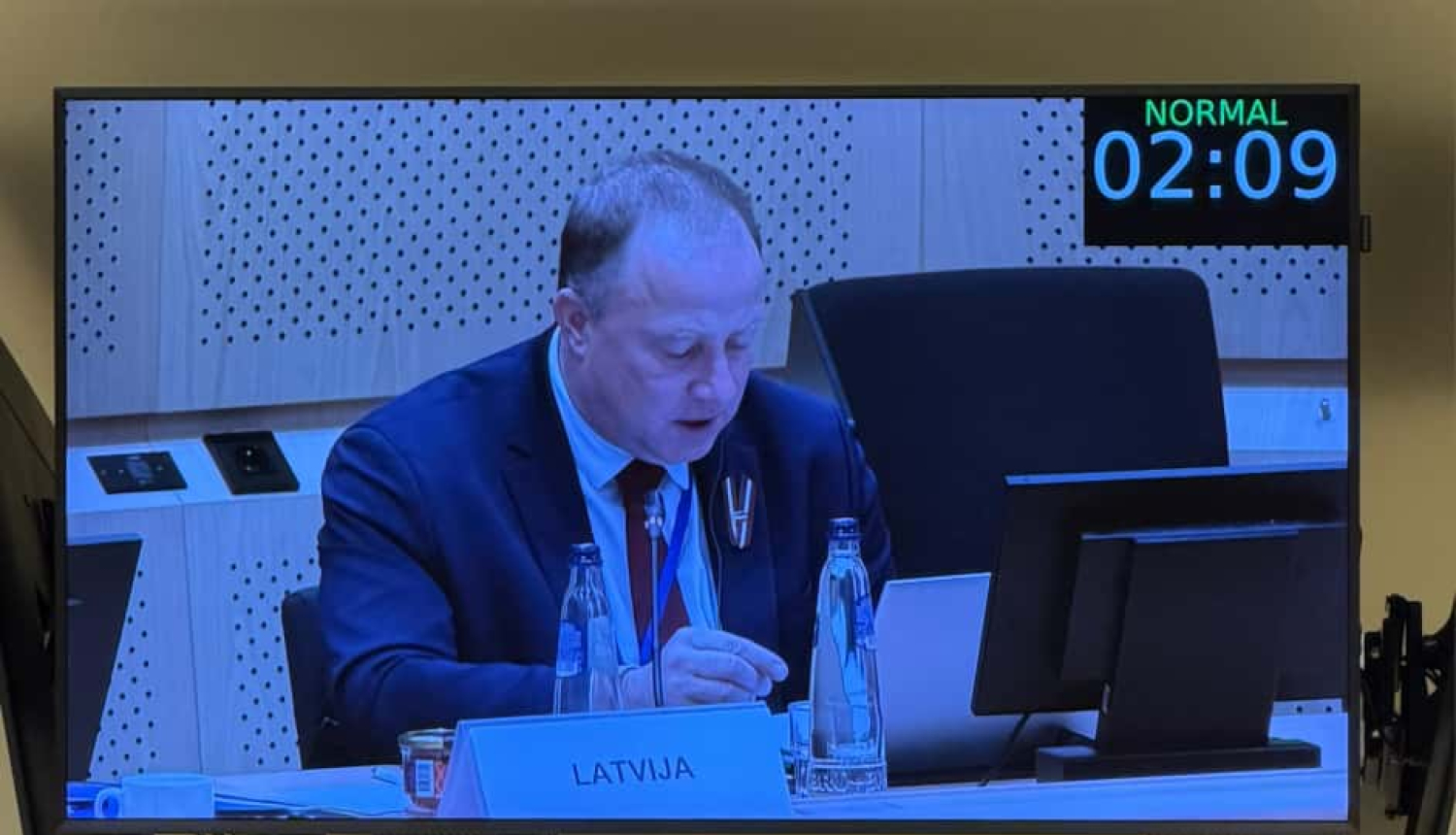
On Monday, November 17th, in Brussels (Belgium), State Secretary of the Ministry of Agriculture Ģirts Krūmiņš took part in a meeting of the EU Agriculture and Fisheries Council, where EU Member States expressed their views on the planned area-based payment support under the Common Agricultural Policy (CAP) post-2027 and on risks to food security, as well as on fishing quotas in EU waters and for EU vessels operating in waters beyond EU jurisdiction.
The discussion on the CAP post-2027, initiated by Denmark as the country holding the Presidency of the Council of the EU, concerned agricultural product reserves that could address the main food security risks while preserving the market orientation of the CAP, and the effectiveness of support payments to farmers in strengthening food security.
State secretary Ģirts Krūmiņš: “We believe there can be no question of reducing funding for the Common Agricultural Policy. The entire funding for agricultural policy must be earmarked in the European Union’s budget with a separate implementation plan. The capacity to strengthen food security depends directly on support for farmers. Therefore, a solution must be found for equalising income support in the next period, as well as for providing additional support to rural regions along the eastern border. The Common Agricultural Policy must be maintained as a separate, stand-alone, targeted support policy, and its funding must be kept at least at the level of the current period.”
Food availability is a strategic objective, but food security is linked to various risks, such as disruptions in supply, climate and geopolitical instability, and plant and animal diseases. Latvia believes that building up reserves of agricultural products can mitigate these risks, but the mechanisms must remain flexible so as to preserve the CAP’s market orientation. However, establishing and maintaining reserves of food and other agricultural products requires significant financial resources, and it is important to understand what potential funding sources are available so as not to create an additional burden on Member States’ budgets. At the same time, in the context of food security it is important that—alongside area-based support—CAP investment support is made available to everyone, including food processing, which is part of the food supply chain.
Officials also exchanged views on fishing quotas for 2026 in EU waters and for EU vessels in waters outside the EU, as well as on fishing quotas for certain stocks for 2027 and 2028. Agreement on the fishing quotas is expected to be reached at the EU Agriculture and Fisheries Council’s meeting in December. As the planned fishing quotas for all stocks have not yet been published, Latvia called on the European Commission to determine the fishing opportunities as early as possible, because it is important to be able to start fishing in January 2026.