


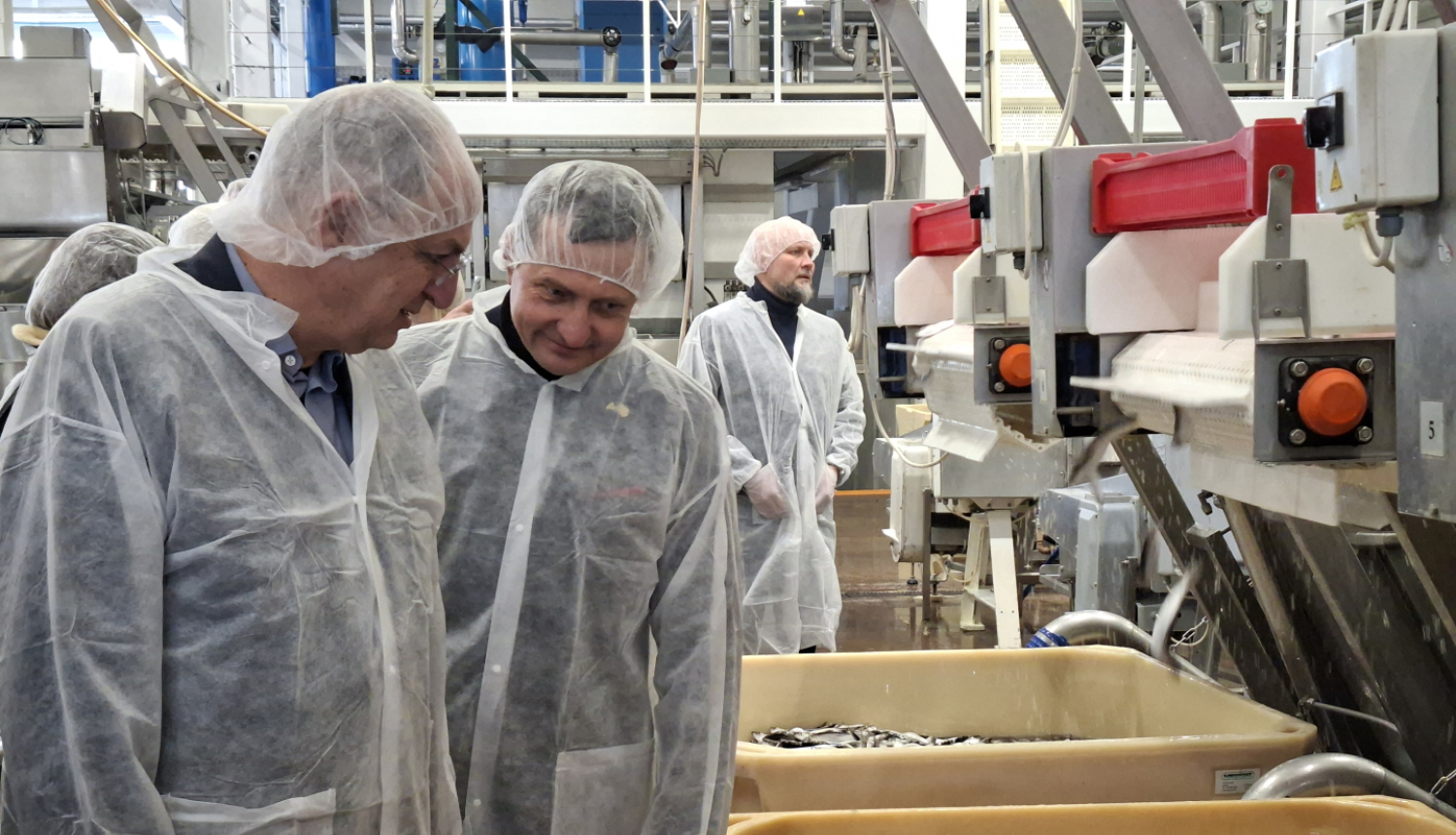
On Thursday, February 19th, the EU Commissioner for Fisheries and Oceans, Costas Kadis, arrived in Latvia on a working visit to gain insight into Latvia’s fisheries and fish processing sectors. Together with Minister for Agriculture Armands Krauze, the Commissioner met with fishermen and fish product producers on the Kurzeme coast.
Minister for Agriculture Armands Krauze: “During the meeting, I emphasised to Commissioner for Fisheries and Oceans Costas Kadis that the Common Fisheries Policy must be significantly simplified by reducing bureaucracy and excessive requirements imposed on fishermen. Unfortunately, so far there have been no substantial efforts from the European Commission in this direction. On the contrary, the fisheries control system is continuously becoming increasingly bureaucratic and complex. Given the decline in many fish stocks, it is extremely important to use every fish caught with the highest possible economic return; however, the current control requirements, particularly the complicated and lengthy procedures for weighing catches in ports, significantly deteriorate the quality of small fish caught in the Baltic Sea – herring and sprat – making them unsuitable for human consumption.”
Minister for Agriculture Armands Krauze also pointed out that the current European Commission proposal for fisheries support in the next planning period 2028–2034 is highly unclear and clearly insufficient to ensure future stability and competitiveness of the fisheries sector, and the local coastal fisheries. Only clearly earmarked and sufficiently allocated funding, fairly distributed among Member States, can ensure a continuous development of the sector and equal conditions for a successful implementation of the Common Fisheries Policy in EU Member States. A sharp reduction in EU funding for the sector post-2027, compared to the current period, would result in the loss of competitiveness for Latvian and EU fisheries in global markets.
In the historic fishing village of Bērzciems on the western coast of the Gulf of Riga, coastal fishermen did not conceal from the EU Commissioner for Fisheries and Oceans that various disproportionate control measures adversely affect coastal fishing, local fish processing, and consequently – the economic viability of coastal residents and entrepreneurs. Control measures must be proportionate and adapted to the specific nature of local fisheries, especially small-scale fisheries. Small-scale fisheries are particularly important for Latvia; however, this sector is increasingly negatively affected by disproportionately strict control and reporting requirements, as well as by a significant increase in the related administrative burden. Currently, coastal fisheries are subject to almost the same rules as large vessels operating at sea. Therefore, a reasonable balance must be found between control requirements and the specific nature of small-scale fisheries, which have minimal impact on the environment and fish resources.
In the port city of Ventspils, Costas Kadis visited one of Latvia’s largest full-cycle fishing and fish processing companies, “Verģi”, whose fish products are appreciated not only in Latvia but also in 30 other countries to which “Verģi” exports its production. For its own processing needs, “Verģi” catches fish (herring and sprat) both in the Gulf of Riga and in the Baltic Sea. At “Verģi”, the EU Commissioner was able to see that Latvia’s fish processing sector holds a significant place in food production and creates value-added products from fish caught in the Baltic Sea, particularly small-sized species – herring and sprat. The production of these products is an integral part of Latvia’s fisheries sector and deserves special attention and support to ensure a sustainable, safe and healthy supply of fish products for both the domestic and foreign markets.
At the end of the day, the Commissioner for Fisheries and the Minister for Agriculture met with Baltic Sea fishermen at the “Vizium” Science Centre in Ventspils, discussing issues such as more targeted investment of EU support in the development of fisheries and in the production of value-added fish products. One possible way to achieve this would be for the European Commission to further decentralise supervision, entrusting greater responsibility for the implementation of support measures and fisheries control to EU Member States, which are much more familiar with the regional specifics of the fisheries sector that differ significantly across EU regions and Member States.
The Ministry of Agriculture has already informed that the EU Commissioner for Fisheries and Oceans, Costas Kadis, is on a two-day working visit to Latvia. On Friday, February 20th, Costas Kadis will visit the company “Karavela” in Riga, one of the largest fish processing companies in Europe, with more than 140 years of historical experience in the production of canned fish and other types of products.