


Minister for Agriculture Armands Krauze has sent a letter to the European Commission (EC), the Cyprus Presidency, and the European Parliament — the key EU institutions working on the next EU Multiannual Financial Framework — presenting a joint request from five EU Member States to allocate additional funding for the convergence of Common Agricultural Policy (CAP) payments. The objective is to ensure that Latvian farmers receive EU CAP support at least at the average EU level in the future.
EC ’s initial proposal for the EU Multiannual Budget for 2028–2034 does not provide for the convergence of CAP payments for Member States whose support levels remain below the EU average. Therefore, Minister for Agriculture Armands Krauze has brought together like-minded countries — Estonia, Lithuania, Bulgaria and Romania — and submitted a joint position and arguments to ensure that the main parties involved in negotiating the EU’s long-term budget understand the issue and decide on allocating additional funding for CAP payment convergence.
Although the formula used for calculating Latvia’s CAP financial envelope for the next period includes funding intended for payment convergence, in practice this additional funding is not allocated to Latvia in the subsequent calculations. Therefore, Armands Krauze has decided to continue discussions with both EU Member States and EU institutions to ensure that Latvian farmers receive the necessary EU funding.
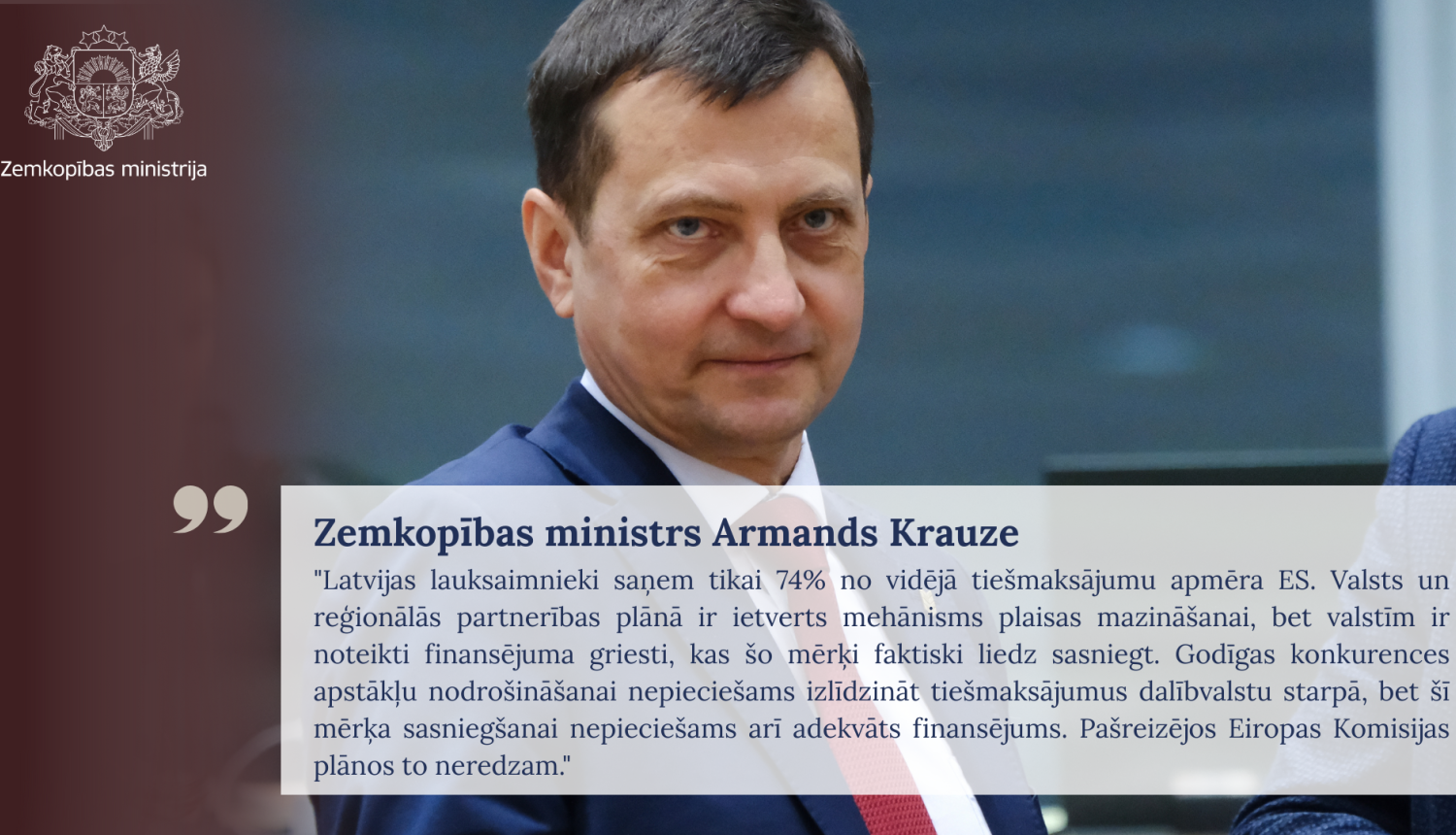
Minister for Agriculture Armands Krauze: “The convergence of direct payments among Member States has been ongoing in various forms for more than 20 years, yet the gap still persists. Latvian farmers receive only 74% of the EU average level of direct payments. The National and Regional Partnership Plan includes a mechanism to reduce this gap, but funding cap imposed on Member States effectively prevent this objective from being achieved. Ensuring fair competition conditions requires the equalisation of direct payments among Member States, but achieving this goal also requires adequate funding. We do not see this reflected in the current plans of the European Commission.”
In their letter, the countries also underline that all Member States face common challenges — food security, climate change, environmental degradation and socio-economic vulnerability in rural areas. Therefore, ensuring equal conditions of competition within the Single Market and fair incomes for farmers across the EU must remain a priority.