


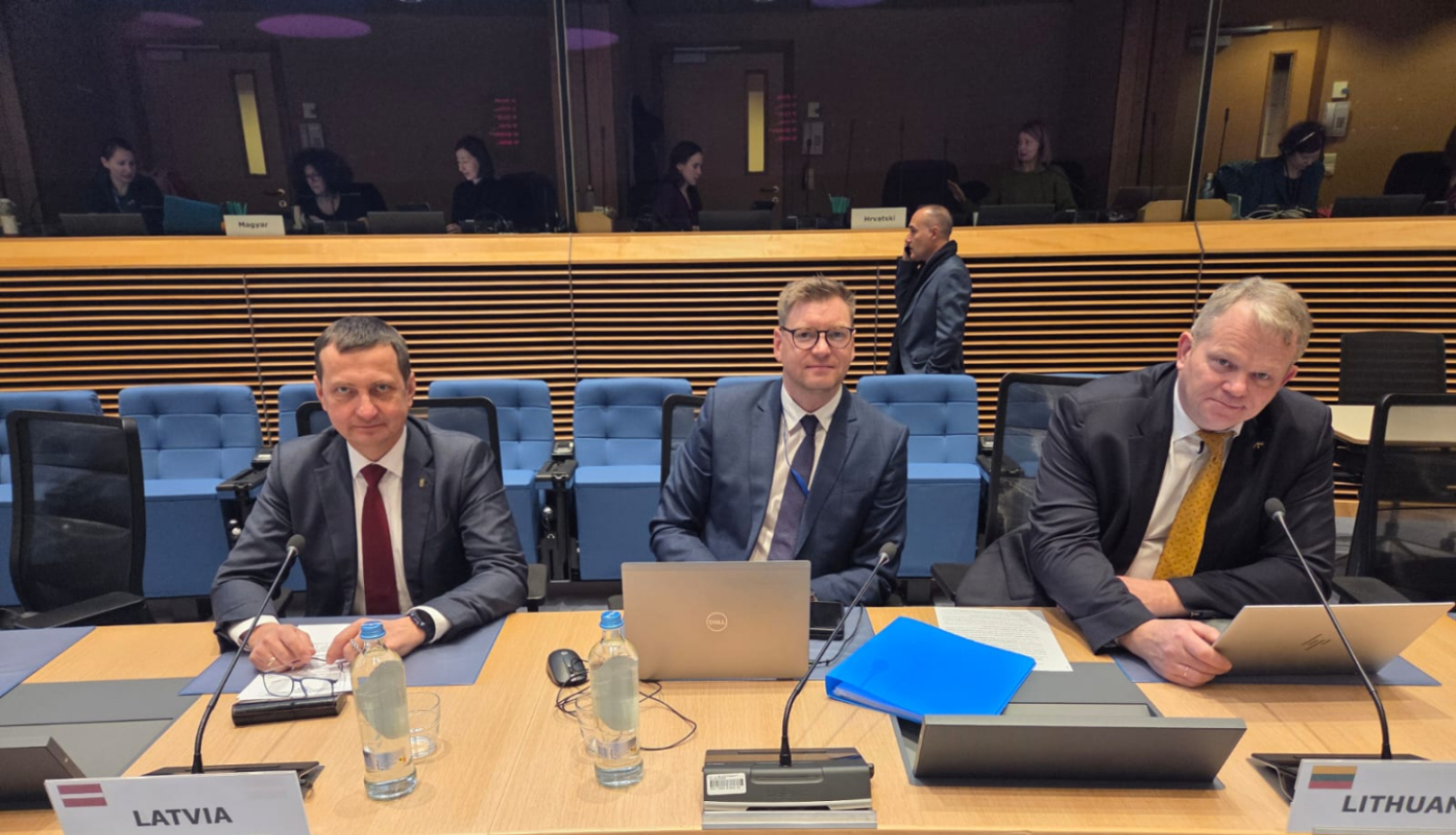
Minister for Agriculture Armands Krauze on Wednesday, January 7th, attended an extraordinary meeting of EU Agriculture Ministers in Brussels on issues related to the competitiveness of EU farmers and trade, convened by the European Commission (EC) in response to the large-scale farmers’ protest that took place in Brussels on December 18th, 2025.
During the meeting, the Minister emphasized that the pressure currently faced by EU farmers and food producers is very high, particularly in the context of high production costs and increased competition.
In response to concerns expressed during the farmers’ protest regarding the reduced level of funding for the Common Agricultural Policy (CAP) post-2027, EU Commissioner for Agriculture and Food Christophe Hansen presented the EC’s latest proposal, which could potentially increase the funding available for the CAP in the next EU Multiannual Financial Framework. This would mean that Member States could already in 2028 allocate part of the currently “frozen” funds to CAP activities or rural development support. These funds are currently planned to be used only after the mid-term review of national and regional plans, which is to be carried out in 2031.
The Minister for Agriculture reiterated Latvia’s firm position that the CAP must not be integrated into a single national and regional partnership plan and fund, as this would endanger the strategic importance of the agricultural and food production sector and the ability to provide support to farmers and rural development. It is also unacceptable that CAP funding at the EU level continues to decrease. Regarding the EC’s latest proposal, the Minister acknowledged that it is a step in the right direction, however, it does not fundamentally address the CAP funding problem, as it does not provide additional resources but merely reallocate funding that has already been allocated.
“Unfortunately, this proposal once again shifts decision-making on the allocation of funding among different policy priorities onto the shoulders of the Member States. This is particularly problematic in the EU’s Eastern border regions, where security and defense are the main priorities. As a result, in Latvia’s case, this proposal does not necessarily guarantee additional funding for the CAP or for rural areas,” Armands Krauze stressed.
The Minister also criticized the fact that external convergence of CAP funding has still not been completed, noting that “despite promises, the current funding allocation formula does not provide Latvia with additional CAP funding. If external convergence is not resolved by the start of the new period in 2028, the gap between EU Member States in terms of CAP support will continue to widen.”
When discussing current sectoral challenges, the Minister highlighted farmers’ concerns about high production costs, which remain particularly high in the Eastern border regions, especially for fertilizers. These costs continue to exceed pre-crisis levels significantly and have a substantial impact on the profitability and viability of farms.
“Instead of alleviating the situation for our farmers, we will further worsen it by applying the new CBAM Regulation. This will lead to an even greater increase in prices for nitrogen fertilizers and in no way contribute either to reducing cheap imports from Russia or to the entry of alternative supplies into the EU,” the Minister stated.
In response to concerns expressed by Latvia and other Member States regarding the impact of the CBAM regulation, or the Carbon Border Adjustment Mechanism, on fertilizer prices, the EC explained that it proposes introducing a new provision that would allow monitoring of CBAM’s impact on the internal market. This would also provide for the possibility, in the event of unforeseen circumstances, to temporarily suspend the application of CBAM to specific goods. This provision would enable the Commission to assess the situation in the fertilizer sector and, if necessary, initiate a temporary suspension of the application of the CBAM regulation.
Addressing trade-related issues, Armands Krauze noted that the EU–Mercosur trade agreement has significant export potential; however, it is essential to ensure effective market safeguard measures that would make it possible to prevent negative consequences for EU producers in the event of an increase in imports. The Minister also stressed that, to protect EU competitiveness and the “One Health” principles, production standards in third countries must be aligned with EU requirements.